Wednesday, 28 May 2014

Workplace Stress


For many people workplace stress is a silent battle as they struggle to get by, fearful of the consequences of admitting to it. But it really shouldn't be that way - a stressed workforce points to failings elsewhere in the organisation. Employee wellbeing is as much the employers responsibility as any other aspect of health and safety.

Work related stress develops when a person feels they cannot cope with the tasks and demands being placed on them or when the demands of the job outweigh their skills and capabilities. This can affect the immune system, cause illness and is a significant cause of sickness absence, high turnover of staff and declining productivity.
Workplace stress is widespread and is not confined to executives or highly pressurised jobs. It affects people at all levels of a business and according to recent research it is not confined to any specific jobs, sectors or industries.

The signs of stress are many and varied and will differ depending on the individual affected. The most obvious signs, from an outside perspective, will be changes in behaviour - which may even impact on the behaviour of the team. An individual may be displaying mood swings, anxiety, become more emotional and over the long term develop worsening anxiety and depression. The individual may notice disturbed sleep patterns or insomnia, negative thoughts, difficulty concentrating and lack of confidence, poor memory and changes in appetite. Physical symptoms may include high blood pressure, increased heart rate, digestive upsets, skin conditions such as psoriasis and sweating or reddening of the skin, muscle tension, stiffness and soreness and suppression of the immune system.
Workplace stress may also affect a group or team. Signs can often be seen within the team and may include; disputes and disaffection within the group; increased staff turnover; increased sickness absence; increase in complaints and grievances; difficulty attracting new staff; poor performance; customer dissatisfaction.

It is not up to managers and employers to diagnose stress, but if you are concerned about an employee recommend that they see a GP. If you notice these signs and symptoms in an employee or group you have a responsibility to address the issues in the workplace that may be causing them, both for ethical and productivity reasons. Look at the work environment and consider how tasks are delegated, how skills are being optimised and how a person's workload suits their skills, knowledge and capabilities. Remember that stress can also be caused when employees feel that they are not achieving their potential; pressure and challenges can be exciting and motivating so long as it is within the person's capabilities to achieve them.


Look at ways to:

• Give all employees a chance to have their voice heard, put forward their thoughts and ideas and ensure these are welcomed and acted upon where necessary. Giving your employees 'ownership' of their role will increase job satisfaction and productivity.

• Once fully trained and competent, give employees room to breathe. Let them prioritise their workload, use their initiative and judgement. Let them know you are there and be approachable for support - only step in when you need to. If employees feel trusted their happiness and productivity will be raised.

• Design the workload and work space to encourage efficiency and challenge the individual without exceeding their capabilities. Structure workload (where possible) so that tasks are spread evenly and give enough notice notice of deadlines. Set realistic targets which inspire the employee to smash them. Reward success and achievements with praise and incentives and individuals should feel motivated to continue to exceed their best.

• Encourage an atmosphere where employees feel they can talk to managers about concerns or stress, without fearing for job security.

Friday, 25 April 2014

Recently Updated Workwear Website


Have you discovered our new website yet? After an overhaul and a makeover, www.bestworkwear.co.uk is looking brand spanking new - we even have some fantastic new shipping rates for all of our customers - including free shipping on UK Mainland orders over £75 in value and great rates on deliveries to Europe - free on orders over £250.

We have also been very busy creating lots of new web pages to provide information and guidance on our range of PPE, the safety standards in use and the legal requirements of workplace health and safety. Up and running at the moment are our Buyers Guides on...

Introduction to PPE

Safety Footwear

Hi Vis

Hearing Protection

Chainsaw PPE

There's more to come so check back regularly - and for any other questions or guidance about our products, you can call our friendly customer service advisors on 08454 65 66 65 Monday - Friday 9 - 5.

Wednesday, 23 April 2014

Leadership Skills


Leadership might seem like something that doesn't apply to the majority of us as we go through the 9-5 routine, perhaps quietly unhappy with things in our workplace, or even in our community, but reluctantly accepting these things because we feel powerless to change them.

But effective leadership isn't just reserved solely for those in charge in the workplace or in a community, it can be achieved by anyone with passion and determination to a cause or to make a change.

Passion and positivity are infectious, so if you set about a challenge with enthusiasm and a 'can-do' attitude you will find that people are naturally drawn to you. Understanding and humility are also crucial in encouraging people to connect with you and your cause. A humble attitude and the willingness to admit to, and learn from, your mistakes will be popular with your followers and the ability to understand and support their needs, wishes, concerns and ambitions will make them feel involved, listened to and valued.


The most important characteristic of a leader is the understanding that their job is to serve others, not the other way around.  What matters to them? How can you help them achieve their potential? And what is your shared vision? Leadership is inclusive not exclusive. Listen to everyone and use their skills and strengths to best advantage. Give everyone a chance to grow under your leadership and they will reward you with their loyalty.

The shared vision is a clear philosophy shared by everyone in the organisation or community. It gives a sense of identity and purpose - what we do/ why we do it/ what do we offer/ what is the message we convey/ what is our goal or vision. Things work much more smoothly and effectively when everyone understands the vision or philosophy and the leadership should inject enthusiasm and encouragement when times are difficult or people are struggling. A great leader will praise people emphatically for a job well done and blame quietly when necessary. Good leadership instils values into people and allows and trusts them to take ownership of a role whilst offering guidance as necessary. A great leader can understand a persons strengths and weaknesses (including their own) and will place them in a role where they can flourish and use their skills to optimum effect.

Communication is critical for effective leadership; listen, consult, involve and explain why as well as what needs to be done. In a large organisation or group communications and the philosophy should be filtered down from the top, ensuring that everyone feels connected and involved with the organisation . Leaders should set a good example to others, by implementing and upholding the values and working methods they put forward.


These tips from respected business leader and writer Jack Welch sum up the qualities and practices of a good leader:

1) There is only one way - the straight way. It sets the tone for the organisation
2) Be open to the best of what everyone, everywhere has to offer. Transfer learning across the organisation
3) Get the right people in the right roles, it is more important than developing a strategy
4) An informal atmosphere is a competitive advantage
5) Make sure everyone counts and everybody knows they count
6) Legitimate self-confidence is a winner - the true test of self confidence is the courage top be open
7) Business has to be fun - celebrations energise an organisation
8) Never underestimate the other guy
9) Understand where real value is added and put the best people there
10) Know when to meddle and when to let go - this is pure instinct

These points are aimed at directors and managers but you can find ways to apply them to your own situation and what you wish to achieve, for example - point 3 - if you feel that you're not in the right role, or your strengths and skills are not being utilised, raise this with a manager, they stand to benefit from better applying your skillset.
It can be hard if you are at 'shop-floor' level to feel ownership of your role or company. But by injecting passion into your job, filling yourself with knowledge about your company, customers and role and by setting a great, positive example to others, you will find things begin to change.

Tuesday, 8 April 2014

London Marathon Weekend

Picture from 'The Telegraph'. 

This weekend sees the London Marathon taking place through the streets of our capital, and whilst most of us will be watching from home (and grateful for it), for the runners it marks the culmination of years of training and dedication. It goes without saying that many of us could benefit from a little more exercise and running (jogging or walking) is a great way to reduce stress or depression and to unwind after a long day at work (even though you may not feel like it!). It can also be a great way to socialise and meet new people; many areas - towns and communities - have a running club where you can meet new people and enjoy their support and motivation rather than 'going it alone'. You may even find a 'running club' in your workplace or perhaps a colleague runs with a local group. The website www.runengland.info has great information and support and can help you find running clubs and routes in your area.

Friday, 28 March 2014

RPE Focus


In hazardous situations poorly fitting PPE can be as ineffective as no protection at all - it may even present it's own risks. A correct fit is particularly important when wearing breathing equipment. Respiratory protection comes in many forms for various environments and hazards, but should always provide a good fit; ensure there is good contact between the skin and the seal of the mask. Take some time, outside of the rush of work, to practice putting on, adjusting and checking the fit of RPE before use. RPE fit testing should be carried out by a competent person who is suitably qualified and experienced. If you are an employer buying for your workplace it is worth buying a range of correct specification RPE and allowing staff to choose the one they feel is most comfortable and the most secure fit for them.

It is also important to ensure that your RPE fits/ interacts well with other head worn PPE. A simple dust mask can be worn easily with a helmet, goggles or ear defenders. Larger breathing apparatus is usually designed to allow for good visibility and leaves room for goggles. Nearly all of our respirators have a narrow adjustable head-strap which leaves room for a helmet or ear defenders.

HSE provide a useful RPE guide which can be downloaded here.

Friday, 14 March 2014

Five Workwear Essentials for Spring

Image: Carhartt Workwear

With the first signs of spring in the air, March is a great time to review your workwear and consider whether your working conditions, or the hazards you face will be changing with the season.
We have compiled a list of five spring essentials - although we cover so many industries it would be impossible to summarise every requirement in five items - so we've gone for a varied range that will hopefully allow us to hit upon some key points of all-round relevance.

1) A light, waterproof hi-visibility jacket. Hi-vis is a crucial item of PPE for anyone working in construction, in warehouses or around lorries and other moving vehicles and highway maintenance to name but a few. If you are working in low light levels or if vehicles are moving in your workspace or you in theirs, it is essential that you can easily be seen. This item also applies to leisurewear; with milder weather on the way you may be feeling more inclined to walk or cycle to work, a hi-vis jacket is the best way to safeguard yourself on these journeys.
A light jacket in a breathable material will help to keep you cool and comfortable, opt for a waterproof though - those April showers are never far away! We recommend the  Dickies SA22042 Hi-Visibility Waterproof Jacket.

Why did the chicken cross the road?
Because she could, safely, in her hi-vis jacket. 


2) A light coverall offering extra comfort and ease of movement. If you regularly wear coveralls you may have invested in a good, insulated pair for the winter. As the weather becomes warmer you'll be looking for a lighter option to keep you comfortable through the summer. Short sleeves and breathable fabric will keep you cool, coveralls offering built in room for movement will be especially comfortable. The Dickies WD2299 Short Sleeve Coverall is a great warm weather coverall with action back feature and elastication for ease of movement.

3) A Short Sleeve Shirt. This one covers a multitude of sins: Our Pilot Shirts are extremely popular with security firms, ambulance crews etc and the short sleeve option is great for keeping cool in what can be a very active job, as well as being ideal for layering. Office staff can find a great range of smart shirts in our office range and for Chefs we stock short sleeve jackets to help you stay cool in the kitchen; these generally include vented backs to allow for air flow and ensure comfort.


4) A quality pair of Safety Boots or Shoes. You may have been wearing thick, insulated boots for the winter, or heavy wellingtons. With spring on its way this is a great time to look around at what's new on the market. Waterproofing and breathability are still important features and comfort soles or energy absorber heels are handy features if your job is about to get busier in the summer months. If you are working as a gardener or groundskeeper, heavy safety boots may cause problems as they are very hard on lawns - safety trainers are a better solution and have many of the same features you would find in safety boots. Always check that the footwear you are buying is suitable for the conditions and risks in your work environment. You can view our Footwear Guide for more tips.

Click Safety Shoes


5) Polo Shirts. A smart, plain Polo Shirt is always a great workwear staple item, either as a stand alone piece for jobs where no strict uniform is needed or to buy on bulk for your workforce. Look for short sleeve options for summer, they can be easily layered up or down to suit the whims of the weather and many styles are available in cool, breathable fabrics. Our range of polo shirts are suitable for embroidery, allowing you to add names or logos to personalise your garments.


Thursday, 6 March 2014

Selecting and Buying Safety Footwear


We stock a great range of safety shoes, trainers, boots and wellies in our online store, but we know that with all this choice it can be hard to know where to start when buying PPE for yourself or your workplace.
Before buying safety footwear (or any PPE) it is a good idea to refer to a recent risk assessment, or if one doesn't already exist this is the ideal opportunity to assess your workplace and/ or working practices. This will give you a solid idea of the existing and potential hazards you need to guard against.
Some points to consider in your risk assessment are:

• Are there slippy surfaces in the workplace?
          If yes, non slip soles will be essential.                                       
Click Safety Boots - a great all rounder

• Is there a risk of impact or crushing to top of foot?
          Metatarsal protectors safeguard the bridge of the foot.

• Is there a risk of objects penetrating the sole?
          Mid-sole protection is required. Composite midsoles provide
          greater coverage.

• Are acids/ alkalis/ chemicals present in the workplace?
          Choose shoes/ boots with acid/ alkali resistant soles. It will help to know the type of chemicals present
          -seek specialist advice.        

• Is there a need for cut protection?
          Chainsaw boots will protect from the cutting power of an active chainsaw.

• Is heel or ankle support required, are staff working on uneven ground?
          Choose a good secure fit, offering plenty of support. Lace up styles will allow workers to customise
          the fit.

• Is there risk of contact with molten metal?
          Foundry boots are specially designed for this hazard. Heat resistance and quick release fastenings are
          important features for this use.
                                                                                       
Cofra Bering BIS Cold Store Boot.
• Are there temperature extremes in the workplace?
          For cold store use you will need to select boots with thermal
          insulation that have been tested to the appropriate temperature.
          For high temperatures look for heat resistant soles tested to the
          appropriate temperature, with a breathable fabric.

• Are there biohazard or hygiene risks?
          Easy clean/ machine washable safety shoes with breathable
          fabric.

• Are employees working in wet conditions?
          Safety wellies offer toe cap and midsole protection with water resistance. Some styles are resistant to
          chemicals.

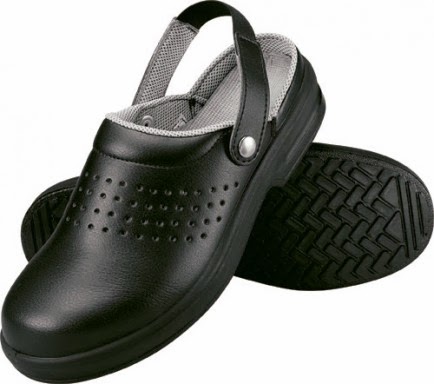
Washable Safety Clog.Comfort for long hours of work.


It is important to regularly check PPE for faults or weaknesses which may prevent it working properly. It is also a good idea to periodically review your safety equipment as new developments and products may have become available.

For further advice on selecting and buying footwear you can view the Safety Footwear Buyer's Guide on our website.